Secure Vibe Coding in 2026: A Practical Workflow for Shipping Fast Without Leaking Keys

Secure Vibe Coding in 2026
Vibe coding has matured from a playful way to prototype into a normal development workflow. Developers describe an outcome, let an agent inspect the project, review the result, and iterate through conversation. The approach is especially valuable for solo founders, designers who code, and small teams without dedicated platform engineers.
The danger is not AI-generated code by itself. The danger is speed without boundaries.
Where Vibe-Coded Apps Leak Secrets
The most common leaks are ordinary:
- An API key is pasted into a prompt or source file.
- A server credential is used inside a client component.
.env.localis accidentally committed.- Terminal output containing a token is shared with an agent.
- A generated debugging script remains in the repository.
- A deployment configuration exposes a secret as a public build variable.
These mistakes are easy to miss because the app still works. The bill or security alert may arrive days later.
The Secure Vibe Coding Loop
1. Define the Trust Boundary First
Before asking an agent to build an integration, decide where credentials live. Browser and mobile bundles cannot safely hold long-lived provider secrets. Route privileged API calls through a server-controlled environment.
2. Use Placeholder Values During Generation
Give the agent variable names such as OPENAI_API_KEY or STRIPE_SECRET_KEY, never the live value. If a test requires authentication, create a restricted development credential with a short lifetime and minimal permissions.
3. Limit Agent Context
Exclude credentials, production data exports, certificates, customer files, and private logs from agent-readable folders. The best prompt is not a substitute for a technical access boundary.
4. Review the Diff, Not Just the Screen
A polished interface can hide an unsafe implementation. Inspect what changed:
- Were server-only files moved into the client bundle?
- Did the agent add an unauthenticated endpoint?
- Were new dependencies introduced?
- Is input validated at the real trust boundary?
- Did a temporary file or fixture capture a credential?
5. Scan Before Every Push
Run secret scanning on the working tree and staged diff. If a real credential reaches Git history, assume it is compromised. Removing the line in a later commit is not enough; rotate the key and investigate usage.
Never ask an agent to “temporarily hardcode” a production key. Temporary code has a habit of becoming permanent history.
A Minimal Checklist for Solo Developers
- Keep secrets in server-side environment variables.
- Maintain an accurate
.gitignore. - Use separate development and production credentials.
- Restrict provider permissions and spending limits.
- Review dependency and lockfile changes.
- Require authentication on privileged routes.
- Run tests and a production build.
- Scan for secrets before push.
- Rotate immediately after confirmed exposure.
Octoshield provides repository-focused credential monitoring for developers who want this protection without a large enterprise security stack. It helps turn secret detection into part of the shipping loop rather than an emergency task after launch.
How to Prompt for Safer Results
Add security acceptance criteria directly to the task:
Implement this integration with server-only environment variables. Do not expose credentials to client code. Add validation, tests for unauthorized access, and verify the final diff contains no secrets or placeholder values that resemble real keys.
This will not guarantee security, but it makes the desired architecture explicit and gives the agent concrete checks to perform.
Conclusion
Secure vibe coding does not mean slowing every idea down with enterprise process. It means protecting the few boundaries that matter: credentials, authorization, data, dependencies, and deployment. With those guardrails in place, agents can accelerate development without turning every prototype into a future incident.
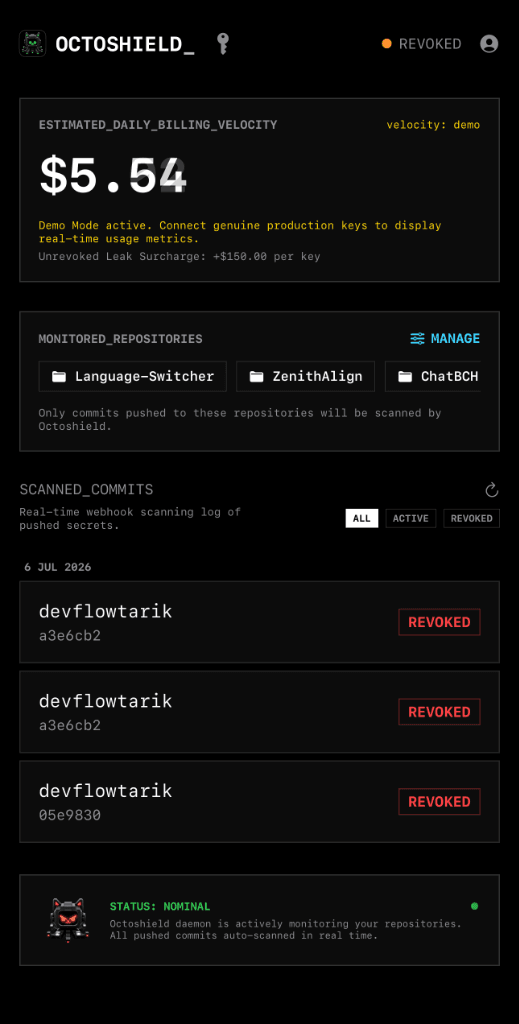
Octoshield in your pocket.
Monitor leaks and manage credentials on the go with our native iOS app.