Vibe Coding the Spacetime Continuum: AI-Driven Gravity Manipulation and Human Oversight

Vibe Coding the Spacetime Continuum: AI-Driven Gravity Manipulation and Human Oversight
The evolution of software development has reached an inflection point. We have moved from assembly language, to high-level object-oriented programming, and now, to Vibe coding gravity manipulation. Developers are no longer writing raw C++ or Rust to calculate the complex tensor mathematics required to stabilize a localized gravity well. Instead, they are using natural language prompts to instruct Large Language Models (LLMs) to generate, deploy, and execute the code in real-time.
While natural language coding gravity drastically accelerates R&D in AI-driven spacetime simulation, it introduces a terrifying new vector for security vulnerabilities. When the code controlling physical spacetime is generated by an AI based on "vibes" and prompts, how do we guarantee safety?
The Dangers of Prompt-Driven Physics
Vibe coding is inherently abstract. A developer might prompt an AI agent: "Create a soft landing zone for a 5-ton cargo container arriving in Sector 7, and make the deceleration feel smooth."
The AI interprets "smooth," generates the complex physics algorithms, and pushes the code to the gravity generator.
1. AI Hallucinations in Spacetime Mathematics
LLMs are prone to hallucinations. In web development, a hallucination might result in a misaligned CSS div. In antigravity engineering, a hallucination regarding the gravitational_constant_modifier could result in the cargo container accelerating downward at 50G instead of decelerating.
engineering teams must implement strict Semantic Validation layers. Before the AI-generated code is executed, a deterministic, non-AI rule engine must analyze the output to ensure the mathematics do not violate the fundamental safety thresholds of the physical hardware.
Prompt Injection Attacks in Gravity Systems If the AI agent processing the natural language commands is connected to external data sources (e.g., reading cargo manifests from an unverified third-party API), an attacker could inject a malicious prompt into the manifest. The AI reads the manifest, executes the hidden prompt, and maliciously alters the gravity field.
Human-in-the-Loop AI and Developer Security
To mitigate the risks of vibe coding, organizations must enforce a strict human-in-the-loop AI architecture.
- Mandatory Peer Review for Physical State Changes: While AI can generate the code, any code block that directly interacts with the
Hardware Abstraction Layer (HAL)of a gravity generator must trigger a manual approval workflow. - Real-Time Prompt Sandboxing: As the developer writes the prompt, a Developer Security AI immediately sandboxes the anticipated output, running a virtual AI-driven spacetime simulation to predict the physical outcome. If the simulation results in a catastrophic anomaly, the prompt is blocked before compilation.
Conclusion
Vibe coding gravity manipulation unlocks unprecedented agility in gravitational engineering, but it cannot exist in a vacuum. By enforcing rigorous human-in-the-loop AI protocols and sandboxing natural language coding gravity prompts, we can harness the power of LLMs without sacrificing the safety of the spacetime continuum.
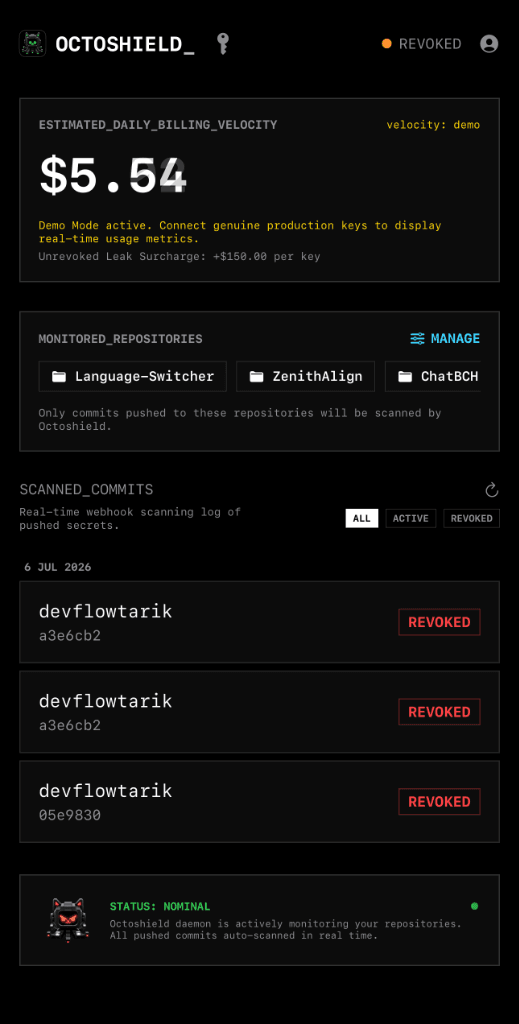
Octoshield in your pocket.
Monitor leaks and manage credentials on the go with our native iOS app.