The Quantum Cryptography Imperative for Interstellar Data Links
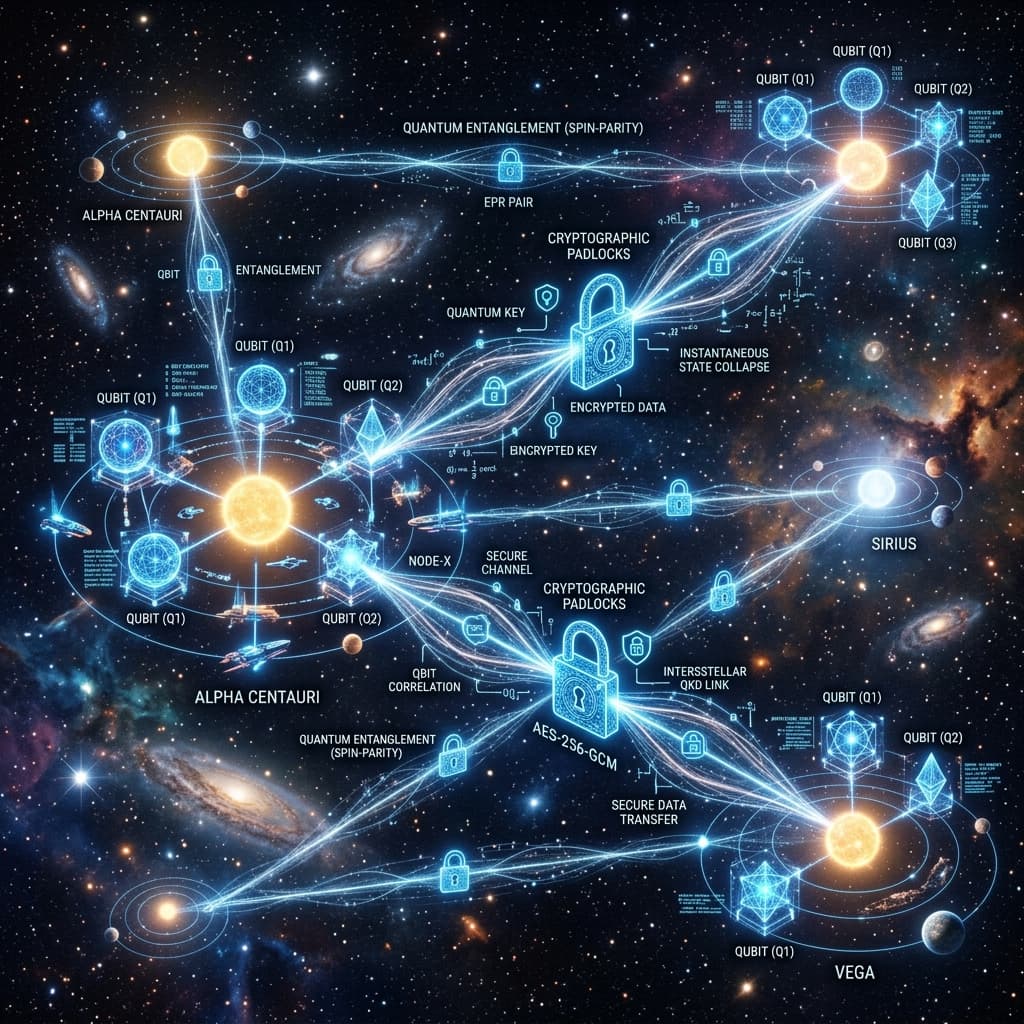
The Quantum Cryptography Imperative for Interstellar Data Links
When you are transmitting telemetry data from a gravity generator on a vessel operating three light-years away from Earth, standard encryption protocols face a catastrophic physical limitation: Time.
If an attacker intercepts a TLS 1.3 handshake packet en route, they have three years to brute-force the key before the packet even reaches its destination. To secure communication across the vastness of the cosmos, we must abandon classical mathematics and embrace physics. The future of interstellar data link security lies entirely in quantum cryptography space links.
The Threat of Time-Lapse Decryption
In terrestrial networks, encryption keys are frequently rotated (often every few minutes). In interstellar communication, a single round-trip transmission can take years. This massive latency gives adversarial AI clusters ample time to capture the transmission, crack the encryption (especially as quantum computers become mainstream), and read the contents of the payload before the sender even knows the packet was intercepted.
If that payload contains the calibration sequences for the vessel's antigravity propulsion system, the results could be devastating.
Quantum Key Distribution (QKD)
To solve this, organizations use QKD to establish quantum cryptography space links. QKD relies on the fundamental principles of quantum mechanics—specifically, the Heisenberg Uncertainty Principle.
Instead of transmitting a mathematical key, the sender transmits a key encoded in the quantum states of individual photons (e.g., their polarization).
The No-Cloning Theorem in Action
According to the no-cloning theorem, it is impossible to create an identical copy of an unknown quantum state. If an attacker intercepts the photon stream to read the key, their very act of observation forces the photon's quantum state to collapse. This instantly alters the photon, introducing a measurable error rate. The receiving vessel will detect this error rate, know the key was compromised, and discard it.
Entanglement-Based Communication
The ultimate goal for interstellar data link security is bypassing the speed of light entirely using quantum entanglement. While we cannot transmit classical information faster than light, entangled qubits can instantly share states across any distance. By linking entangled nodes on Earth with nodes on interstellar vessels, we can create a cryptographic channel where eavesdropping is not just mathematically difficult, but physically impossible.
Conclusion
Standard encryption is bound by time, making it uniquely vulnerable in deep space. By leveraging the laws of quantum physics, quantum cryptography space links guarantee that our most critical infrastructure—no matter how many light-years away—remains mathematically unhackable and physically secure.
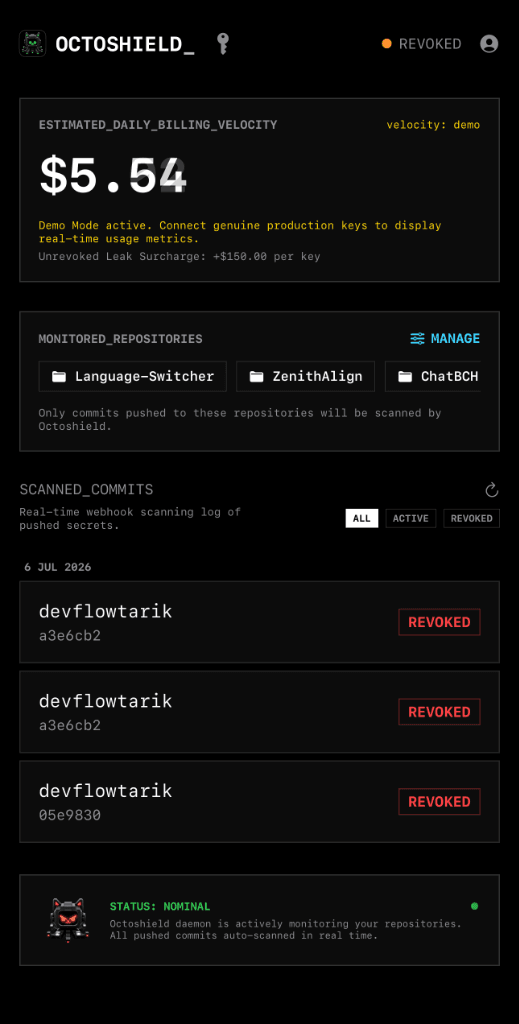
Octoshield in your pocket.
Monitor leaks and manage credentials on the go with our native iOS app.