Llama 4 for Cybersecurity: Real-Time Secret Scanning in decentralized DevOps

Llama 4 for Cybersecurity: Real-Time Secret Scanning in Decentralized DevOps
The complexity of modern software repositories requires tools that can understand context. In 2026, standard pattern-matching (regex) scanners struggle with the sheer volume of microservices and fluid variable declarations in vibe-coded environments. To solve this, engineering teams are deploying Llama 4 for cybersecurity tasks, specifically fine-tuning the open-weights model to run real-time secret scanning across decentralized DevOps pipelines.
Using Llama 4 for cybersecurity allows us to scan complex files for API keys, database connection parameters, and authentication tokens with unprecedented accuracy. Let's explore how to integrate Llama 4 into your CI/CD pipelines and configure the model for optimal security compliance.
Why Regular Scanners Fail in 2026
Traditional secret scanners rely on static signatures. They look for specific prefixes (e.g., AKIA... for AWS keys) or calculate the entropy of a string. While this works for standard providers, it creates substantial problems:
- High False Positive Rates: Cryptographic salts, random hashes, and temporary test strings get flagged constantly, leading to developer alert fatigue.
- Missing Custom Formats: Proprietary internal database strings or custom API keys often slip past because they don't match standard signatures.
Llama 4 solves this by evaluating code semantically. Instead of looking for random characters, it understands the context surrounding the code:
javascript snippet// A static scanner might miss this due to low entropy, but Llama 4 flags it immediately
const gatewayToken = decrypt("a2V5X3NlY3JldF8xMjg=");
The model reads the variable name, the decryption function, and determines with high confidence that this block is resolving an active authentication parameter.
Implementing Llama 4 in DevOps Pipelines
To run Llama 4 for cybersecurity checks, organizations must avoid sending code to public external APIs. Instead, leverage the model's open-weights nature to deploy it locally or inside your private VPC.
1. Private VPC Hosting
Deploy Llama 4 (using quantization like FP8 to reduce memory footprint) on private GPU nodes. Configure your runner to send code diffs to this private endpoint during the pre-commit or CI build phases.
2. Fine-Tuning on Secret Formats
To maximize performance, fine-tune Llama 4 on a curated dataset of:
- Standard and custom API token patterns.
- Hardcoded password variables.
- Obfuscation techniques (e.g., Base64 strings, environment configuration files).
- False positive examples (like test mocks or public keys) to reduce alert fatigue.
Model Weight Confidentiality If you fine-tune Llama 4 on your organization's internal code patterns and custom token formats, the model weights themselves become sensitive assets. If an attacker gains access to your fine-tuned model, they can reverse-engineer the training data to discover your proprietary token structures. Secure your model store with strict IAM controls.
Hybrid Scanning: The Best of Both Worlds
While Llama 4 offers incredible semantic analysis, regex scanners are still much faster for basic matching. The most secure architecture uses a hybrid approach:
- First Pass (Fast Signature Matching): A fast engine like Octoshield scans the diff for known token formats. If it finds a signature, it flags it instantly.
- Second Pass (Semantic AI Scan): Any ambiguous, high-entropy variable or suspicious encryption block is routed to Llama 4 for deep contextual verification.
How Octoshield Integrates Next-Gen AI Detection At Octoshield, we combine high-speed signature matching engines with advanced semantic models. This hybrid approach ensures you catch 100% of leaked secrets—from standard AWS keys to custom database tokens—with sub-millisecond local scan latency and zero false positives.
Conclusion
Deploying Llama 4 for cybersecurity represents a major evolution in how we defend our code repositories. By moving from static signature matching to contextual AI analysis, teams can eliminate alert fatigue and intercept complex security vulnerabilities. When paired with high-speed detection engines like Octoshield, you can build a truly modern, resilient DevOps pipeline.
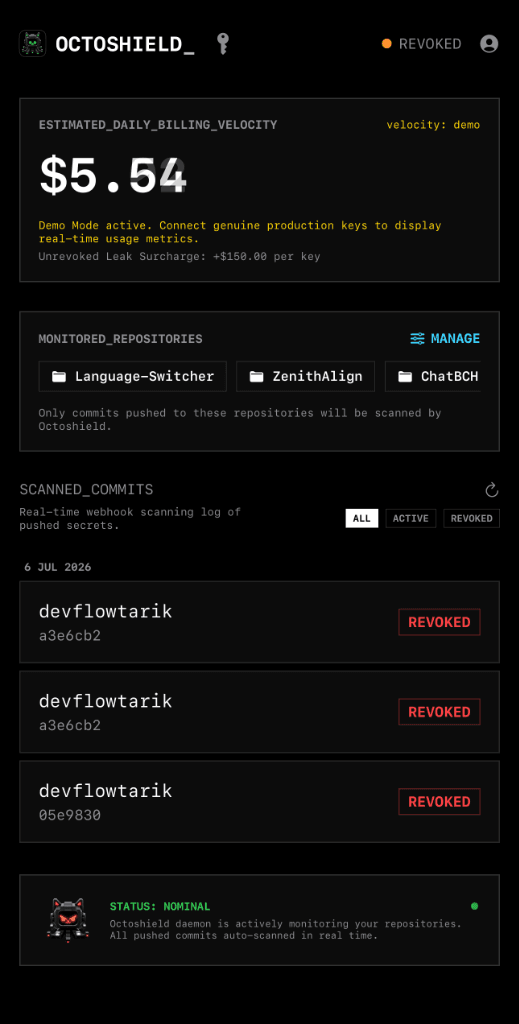
Octoshield in your pocket.
Monitor leaks and manage credentials on the go with our native iOS app.