GPT-5.6 Sol for Coding: Capabilities, Security Risks, and Safe Agent Workflows
GPT-5.6 Sol for Coding: Capabilities, Security Risks, and Safe Agent Workflows
OpenAI released the GPT-5.6 family on July 9, 2026, with GPT-5.6 Sol positioned as its flagship model for difficult coding and long-horizon agent work. Sol is available through ChatGPT, Codex, and the OpenAI API, alongside the lower-cost Terra and Luna variants.
For developers, the important change is not simply that the model writes better functions. GPT-5.6 can coordinate tools, process intermediate results, monitor progress, and decide what to do next. Inside a coding agent such as Codex, that means reading a repository, editing files, running tests, inspecting failures, and continuing until the requested outcome is complete.
That autonomy is powerful—but it also expands the security boundary.
What Makes GPT-5.6 Sol Different for Coding?
Traditional code assistants generated a snippet and waited for the developer to paste it. An agentic GPT-5.6 workflow can operate across the entire software lifecycle:
- Understand architecture across many files.
- Create an implementation plan and revise it as evidence changes.
- Run compilers, test suites, linters, and local utilities.
- Coordinate parallel subtasks through multiple agents.
- Review visual output and compare it against a target.
- Produce a finished patch rather than a single suggestion.
OpenAI reports that GPT-5.6 Sol reaches state-of-the-art results on several coding-agent evaluations. Benchmarks are useful signals, but they do not determine whether an agent is safe inside your specific repository. The practical question is: what can the agent access, and what can it change without approval?
The Main Security Risks
1. Credentials Entering Agent Context
An agent may inspect terminal logs, configuration files, test fixtures, or deployment scripts. If these contain live tokens, the credentials can become part of the agent session even when they were unrelated to the task.
Keep .env files, certificates, production exports, and local credential stores outside the agent-readable workspace whenever possible. Do not assume that a filename alone creates a security boundary.
2. Secrets Written into Generated Files
Fast prototypes often use temporary credentials. An agent may create a debugging script, fixture, or copied API request that contains a real value. The file can later be committed by a human or another agent.
Secret scanning should run against the working tree and staged diff—not only after code reaches the remote repository.
3. Excessive Shell and Network Permissions
Coding agents can install dependencies, execute package scripts, and call external services. A malicious repository instruction or compromised dependency can attempt to turn these capabilities against the developer.
OpenAI describes the Codex sandbox as the technical boundary controlling writable paths, protected locations, and network access. Keep that boundary narrow. Low-risk test commands can run automatically, while network access, credential use, deployment, and destructive commands should require explicit approval.
4. Confident but Incorrect Security Changes
A patch can compile and still weaken authorization, expose a server-only key to the browser, or remove a validation step. Agents need the same review discipline as human contributors.
Agent output is untrusted code until it has passed tests, security checks, and human review. A stronger model reduces some mistakes; it does not eliminate the need for controls.
A Safe GPT-5.6 Coding Workflow
Use a layered workflow rather than relying on one protection:
- Start the agent in a restricted workspace.
- Exclude production secrets and sensitive exports.
- Give the task a narrow definition of done.
- Require approval for network, deployment, and credential access.
- Run unit, integration, and authorization tests.
- Scan the complete diff for keys, tokens, and passwords.
- Review generated dependencies and lockfile changes.
- Inspect the final patch before merge.
Octoshield complements this process by monitoring repositories for exposed credentials and giving developers a focused place to review leak alerts. If an agent generates a credential-bearing file, detection should happen before that file becomes a permanent part of Git history.
Sol, Terra, or Luna?
Use Sol when the task requires sustained reasoning, difficult debugging, or coordination across many systems. Terra can be a better default for everyday implementation, while Luna fits high-volume, lower-complexity work. Security permissions should not automatically expand with model capability. In fact, the more capable the agent, the more important clear boundaries become.
Sources and Further Reading
Conclusion
GPT-5.6 Sol makes coding agents more useful for complete engineering outcomes, not just code completion. The safest teams will pair that capability with restricted execution, auditable actions, repository scanning, and mandatory review. Agent speed is valuable only when credentials and production boundaries remain intact.
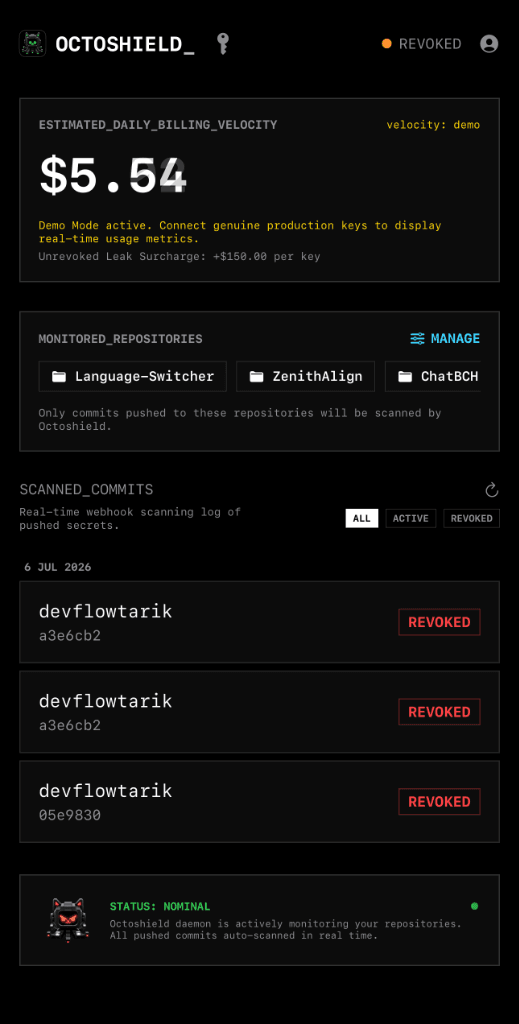
Octoshield in your pocket.
Monitor leaks and manage credentials on the go with our native iOS app.