Claude Fable 5 vs GPT-5.6 Sol for Coding: Security, Cost, and Agent Workflows

Claude Fable 5 vs GPT-5.6 Sol for Coding
Claude Fable 5 and GPT-5.6 Sol arrived within weeks of each other and target the same difficult category: ambitious, long-running work that agents could not reliably complete in earlier generations.
Anthropic describes Fable 5 as a model for multi-day coding projects that can plan across stages, delegate to sub-agents, test its own work, and use vision to compare implementation output with a goal. OpenAI positions GPT-5.6 Sol as its strongest coding model, emphasizing performance per token, programmatic tool coordination, and multi-agent execution.
Both can be excellent. Neither should receive unrestricted access to production systems.
Capability and Workflow Differences
| Area | Claude Fable 5 | GPT-5.6 Sol | | --- | --- | --- | | Best fit | Long-running, ambitious projects | Complex coding and tool-heavy workflows | | Agent surfaces | Claude Code and managed agent harnesses | Codex, ChatGPT, and Responses API | | Multi-agent work | Delegation to sub-agents | Multi-agent beta and tool programs | | Published API price | $10 input / $50 output per million tokens | $5 input / $30 output per million tokens | | Security approach | Cyber safeguards and fallback routing | Layered safeguards, monitoring, and trust-calibrated access |
Pricing and benchmark results can change, so teams should verify the current provider pages before standardizing procurement decisions.
When Fable 5 Makes Sense
Fable 5 is designed for work that benefits from patience: large migrations, complex implementations, deep review, and tasks that may run asynchronously for days. Its ability to check its own work and use vision is attractive for teams handing an agent an outcome rather than a narrowly scoped code edit.
Anthropic also applies additional cybersecurity safeguards to Fable 5. Some flagged requests may route to another Claude model. That reduces certain misuse risks but does not protect a repository from an accidentally committed credential or an overly permissive tool configuration.
When GPT-5.6 Sol Makes Sense
Sol is compelling when a workflow contains many tool calls and intermediate decisions. OpenAI reports strong coding-agent performance with fewer output tokens and lower estimated cost than Fable 5 on specific evaluations.
The Responses API can let GPT-5.6 write lightweight programs that coordinate tools and intermediate results. This can reduce orchestration overhead, but it also makes tool definitions and permissions part of your security architecture.
The Security Comparison That Actually Matters
Model-level safeguards are only one layer. Repository security depends on the surrounding agent harness:
- Is execution sandboxed?
- Is network access disabled by default?
- Can the agent read
.envfiles? - Are tool actions logged?
- Does deployment require approval?
- Are generated changes scanned for secrets?
- Can a human inspect the complete diff?
The safer model is the one running inside the safer system. A capable model with narrow permissions, clean context, and review gates is generally less risky than a supposedly conservative model with unrestricted shell and network access.
Recommended Selection Strategy
Choose Fable 5 for high-complexity work where long-horizon planning and careful iteration matter more than lowest cost. Choose GPT-5.6 Sol when tool coordination, speed, and efficient agent execution are central.
For routine tasks, use smaller models where they are sufficient. Do not spend frontier-model tokens on repetitive formatting or low-risk mechanical work, and do not grant every model the same permissions merely because they share an agent interface.
Regardless of selection:
- Keep production credentials outside the workspace.
- Use least-privilege repository and tool access.
- Require approval for external writes and deployments.
- Scan generated files and staged changes.
- Review authorization and data-boundary changes manually.
Sources and Further Reading
- Anthropic: Claude Fable 5
- Anthropic: Fable 5 cyber safeguards
- OpenAI: GPT-5.6
- OpenAI: Running Codex safely
Verdict
There is no universal winner. Fable 5 is optimized for ambitious, sustained agent work; GPT-5.6 Sol emphasizes strong coding performance and efficient tool orchestration. The durable competitive advantage is not choosing one model forever—it is building an agent environment where models can be swapped without weakening credential hygiene, approvals, auditability, or repository review.
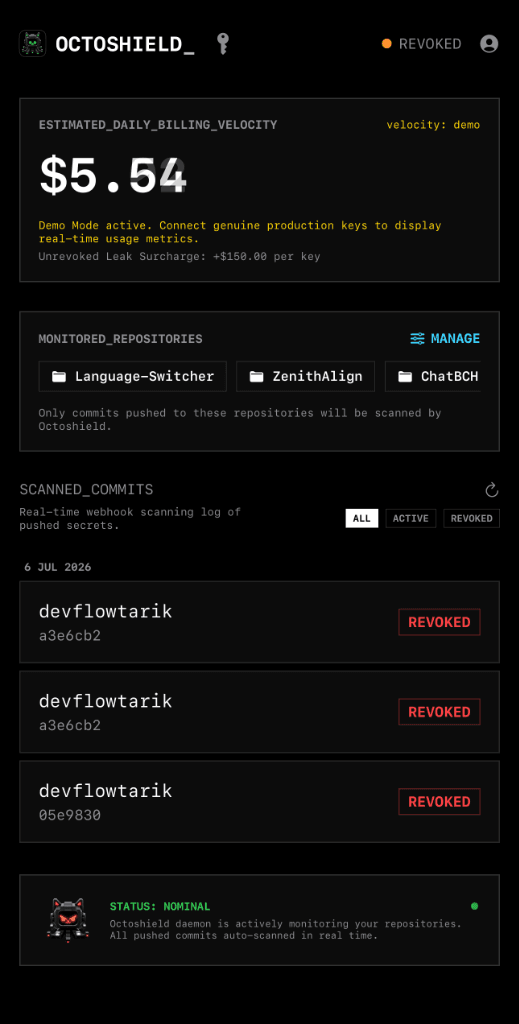
Octoshield in your pocket.
Monitor leaks and manage credentials on the go with our native iOS app.